
 3927
3927  4921
4921加快构建全国统一大市场,在更大范围内深化分工,是提升供应链韧性与安全水平的坚实基础。文章采用2015—2022年FactSet Revere全球企业供应链关系数据识别供应链断裂问题,实证分析市场分割对我国企业供应链断裂的影响效应和作用机制。研究发现:(1)市场分割水平提升会显著提高企业的供应链净断裂率,从而导致供应链韧性水平下降,且该结果在利用地理信息构建工具变量开展因果识别等一系列稳健性检验后依然显著成立。(2)市场分割主要通过加剧中间品错配和提高信息不对称程度增加企业的供应链净断裂率。(3)市场分割带来的供应链断裂效应存在典型的非对称特征,即其仅对上游供应商存在显著影响,但对下游客户的影响并不显著;市场分割带来的供应链断裂效应将导致进一步的福利损失,具体表现为净断裂率的提高将显著降低供应链运转效率和加剧企业经营风险。(4)统一市场基础制度规则以及大力发展数字经济能够有效缓解市场分割对供应链净断裂率的负面冲击。
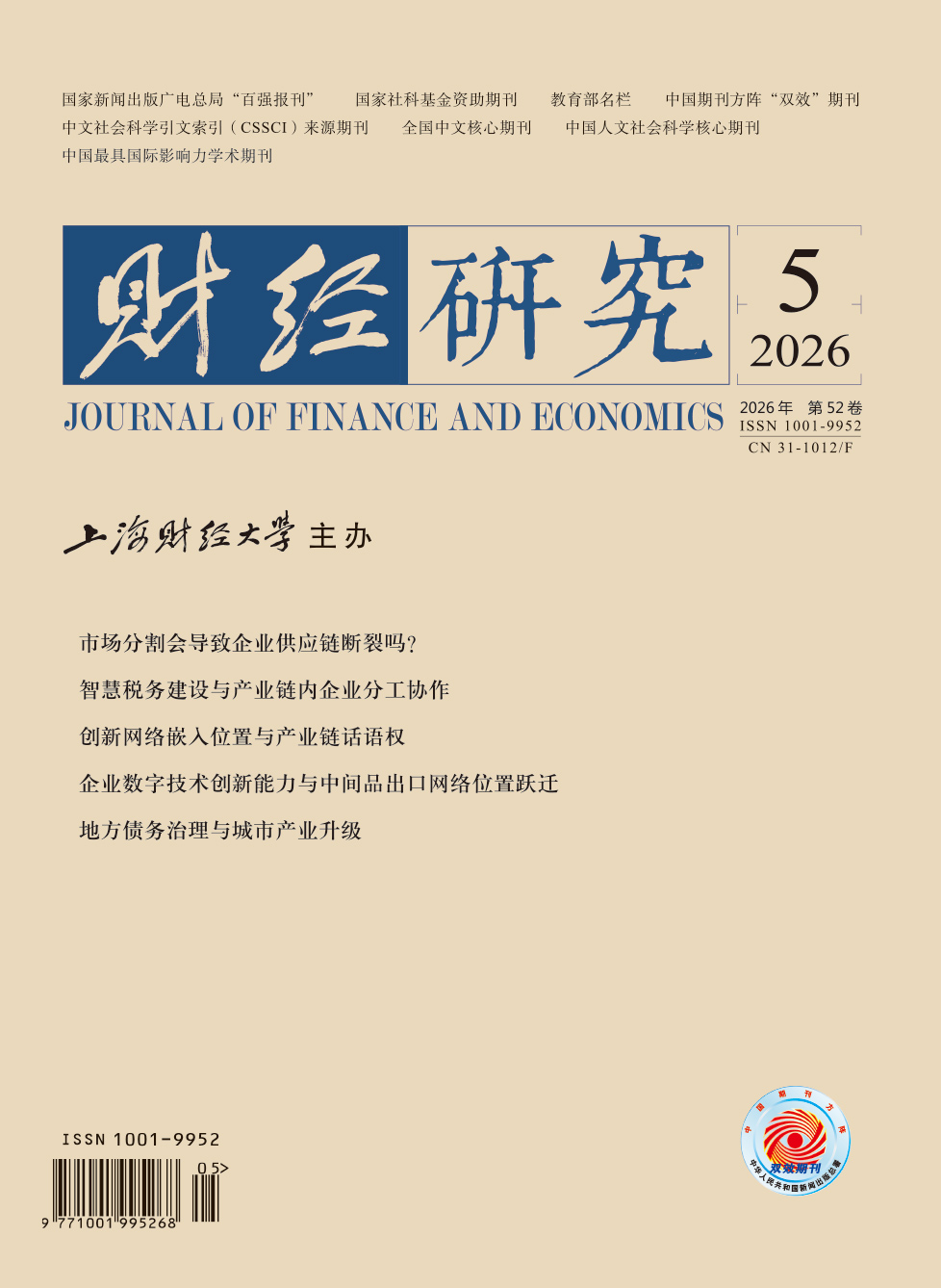
市场分割会导致企业供应链断裂吗?——兼论统一大市场构建的障碍破除
摘要
参考文献
相关附件
5 江艇, 孙鲲鹏, 聂辉华. 城市级别、全要素生产率和资源错配[J]. 管理世界, 2018, (3): 38−50. DOI:10.3969/j.issn.1002-5502.2018.03.004
8 刘志彪. 全国统一大市场[J]. 经济研究, 2022, (5): 13−22.
18 陶锋, 王欣然, 徐扬, 等. 数字化转型、产业链供应链韧性与企业生产率[J]. 中国工业经济, 2023, (5): 118−136. DOI:10.3969/j.issn.1006-480X.2023.05.007
24 张宽, 雷卓骏, 李后建. 市场准入管制与企业全要素生产率: 来自负面清单的证据[J]. 世界经济, 2023, (5): 152−176.
26 Aker J C, Klein M W, O'Connell S A, et al. Borders, ethnicity and trade[J]. Journal of Development Economics, 2014, 107: 1−16. DOI:10.3386/w15960
27 Alfaro L, Chor D. Global supply chains: The looming “great reallocation”[R]. NBER Working Paper No. 31661, 2023.
28 Barrot J N, Sauvagnat J. Input specificity and the propagation of idiosyncratic shocks in production networks[J]. The Quarterly Journal of Economics, 2016, 131(3): 1543−1592. DOI:10.1093/qje/qjw018
29 Barwick P J, Cao S M, Li S J. Local protectionism, market structure, and social welfare: China’s automobile market[J]. American Economic Journal: Economic Policy, 2021, 13(4): 112−151. DOI:10.1257/pol.20180513
30 Bernard A B, Moxnes A, Saito Y U. Production networks, geography, and firm performance[J]. Journal of Political Economy, 2019, 127(2): 639−688. DOI:10.1086/700764
31 Bonadio B, Huo Z, Levchenko A A, et al. Global supply chains in the pandemic[J]. Journal of International Economics, 2021, 133: 103534. DOI:10.1016/j.jinteco.2021.103534
32 Carvalho V M, Nirei M, Saito Y U, et al. Supply chain disruptions: Evidence from the Great East Japan Earthquake[J]. The Quarterly Journal of Economics, 2021, 136(2): 1255−1321. DOI:10.1093/qje/qjaa044
33 Crosignani M, Macchiavelli M, Silva A F. Pirates without borders: The propagation of cyberattacks through firms’ supply chains[J]. Journal of Financial Economics, 2023, 147(2): 432−448. DOI:10.1016/j.jfineco.2022.12.002
34 Donaldson D. Railroads of the Raj: Estimating the impact of transportation infrastructure[J]. American Economic Review, 2018, 108(4-5): 899−934. DOI:10.1257/aer.20101199
35 Elliott M, Golub B, Leduc M V. Supply network formation and fragility[J]. American Economic Review, 2022, 112(8): 2701−2747. DOI:10.1257/aer.20210220
36 Fang H M, Li M, Wu Z N. Tournament-style political competition and local protectionism: Theory and evidence from China[J]. Journal of Public Economics, 2025, 248: 105421. DOI:10.1016/j.jpubeco.2025.105421
37 Hsieh C T, Klenow P J. Misallocation and manufacturing TFP in China and India[J]. The Quarterly Journal of Economics, 2009, 124(4): 1403−1448. DOI:10.3386/w13290
38 Huang Y, Lin C, Liu S B, et al. Trade networks and firm value: Evidence from the U. S. -China trade war[J]. Journal of International Economics, 2023, 145: 103811.
39 Khanna G, Morales N, Pandalai-Nayar N. Supply chain resilience: Evidence from Indian firms[R]. NBER Working Paper No. 30689, 2022.
40 Luo C Y, Wang N. U. S. -China trade frictions and supply chain reconstruction: Perspective from indirect links[J]. Journal of International Money and Finance, 2025, 151: 103256.
41 Mao Q L, Guo C Y. Industrial robots, supply chain spillover effect and firm employment: Evidence from China[J]. Journal of Economic Behavior & Organization, 2025, 229: 106858. DOI:10.1016/j.jebo.2024.106858
42 Tang W, Wang Y, Wu J M. Local favoritism in China’s public procurement: Information frictions or incentive distortion?[J]. Journal of Urban Economics, 2025, 145: 103716. DOI:10.1016/j.jue.2024.103716
本论文包含如下附件:
| 序号 | 标题 | 大小 | 查看/下载 |
|---|---|---|---|
| 1 | 数据及程序代码 | 1221.3 (KB) |  |
引用本文
吕越, 张杰, 陈泳昌. 市场分割会导致企业供应链断裂吗?——兼论统一大市场构建的障碍破除[J]. 财经研究, 2026, 52(5): 4-18.
导出参考文献,格式为:
上一篇:省际结对帮扶与乡村振兴