
 5886
5886  9764
9764Urban modernization is a critical element in advancing Chinese-style modernization. The development of urban modernization aligns closely with the characteristics of Chinese-style modernization, specifically reflected in a robust economic foundation, a harmonious social environment, strong innovation dynamics, a low-carbon ecological environment, and an inclusive cultural atmosphere. Based on the connotations and features of urban modernization, this paper constructs an urban modernization indicator system from the perspectives of economic, social, innovative, green, and cultural development, and measures the level of urban modernization in the Yangtze River Delta (YRD) region. The study finds that, overall, the level of urban modernization in the YRD region and its dimensions show an upward trend. Affected by the urbanization process, Shanghai leads in urban modernization, with Jiangsu and Zhejiang remaining in the middle, while Anhui ranks lower. In terms of temporal trends, Zhejiang’s urban modernization growth rate is relatively higher, primarily due to its comprehensive advantages in innovation-driven development, a favorable business environment, and the vitality of its private economy. Regarding regional disparities, the unevenness of urban modernization in the YRD region first increases and then stabilizes. Jiangsu exhibits the highest degree of imbalance, mainly due to the economic development gap between southern and northern Jiangsu. From an overall disparity decomposition perspective, the unevenness of urban modernization in the YRD region primarily results from interregional differences. However, as the integration process of the YRD region deepens, these regional differences have narrowed. The dynamic evolution trend shows that the urban modernization distribution curve has shifted to the right, with the peak height decreasing, the peak width expanding gradually, and a noticeable rightward tail, maintaining a unimodal distribution. In terms of spatial distribution, urban modernization in the YRD region shows a pattern of “higher in the southeast, lower in the northwest”, with significant positive spatial correlation. High-level urban modernization areas are mainly concentrated around Shanghai and Suzhou. Promoting high-quality urban development and fostering regional coordinated development are two key paths to achieve urban modernization in the YRD region. The conclusions of this paper provide important insights for deeply understanding the patterns of urban modernization development and advancing urban modernization within the process of Chinese-style modernization.
 / Journals / Journal of Shanghai University of Finance and Economics
Journal of Shanghai University of Finance and Economics
LiuYuanchun, Editor-in-Chief
ZhengChunrong, Vice Executive Editor-in-Chief
GuoChanglin YanJinqiang WangWenbin WuWenfang, Vice Editor-in-Chief
Measurement and Evaluation of Urban Modernization: A Case Study of the Yangtze River Delta Region
Journal of Shanghai University of Finance and Economics Vol. 27, Issue 03, pp. 64 - 78 (2025) DOI:10.16538/j.cnki.jsufe.2025.03.005
Summary
References
Summary
Cite this article
Wu Youmeng, Sun Hao, Wang Xianzhu. Measurement and Evaluation of Urban Modernization: A Case Study of the Yangtze River Delta Region[J]. Journal of Shanghai University of Finance and Economics, 2025, 27(3): 64-78.
Export Citations as:
For
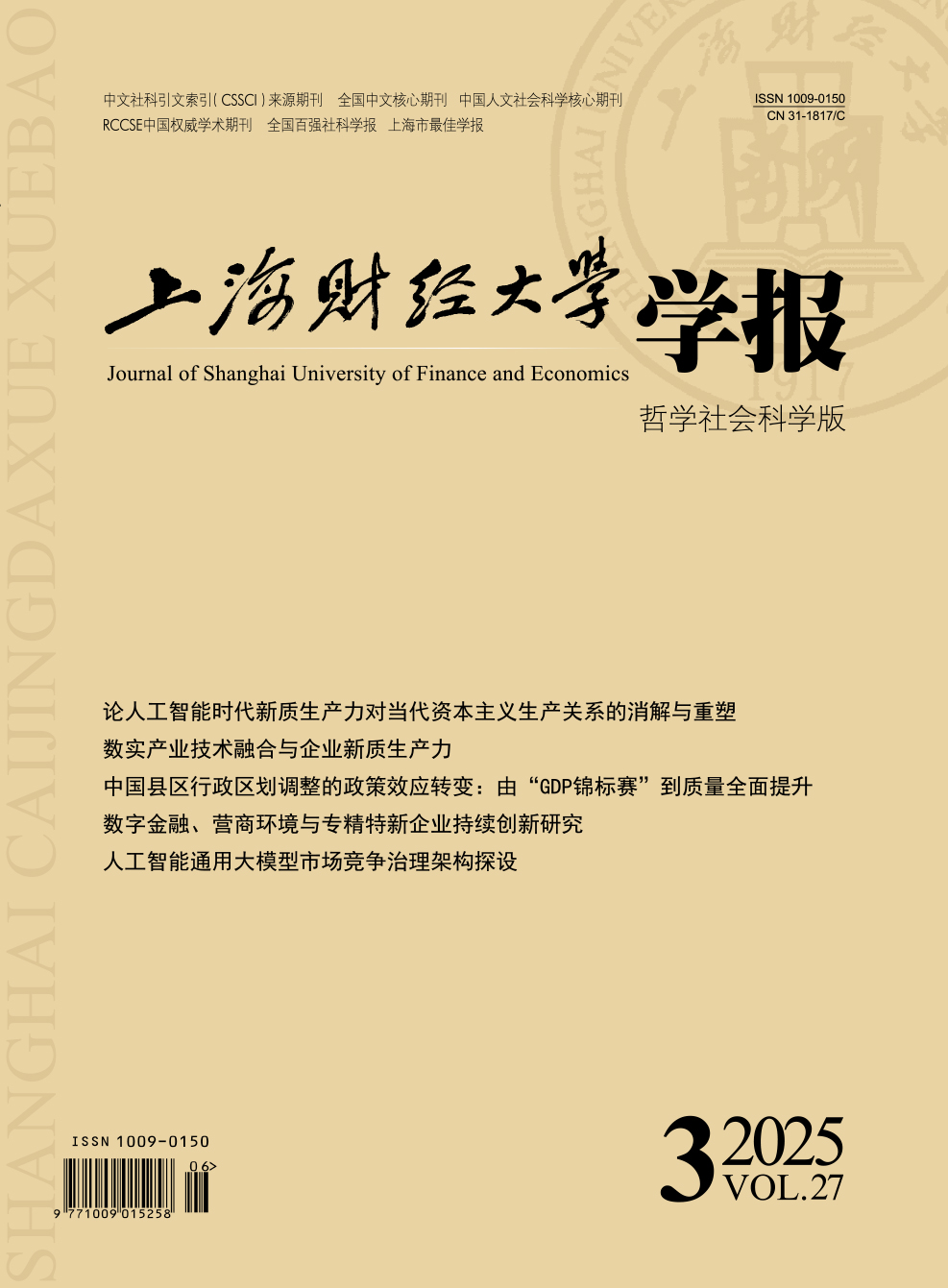
ISSUE COVER
RELATED ARTICLES