
 5292
5292  11032
11032Following the Central Financial Work Conference’s clear proposal to develop digital finance as a key priority, financial holding groups serve as an important carrier for integrating resources across different financial sectors. Building internal data-sharing systems within these groups has become essential for extracting data value and creating business synergies. However, China’s financial holding groups currently face three main challenges in data sharing: First, the regulatory system is fragmented and compliance requirements often conflict due to overlapping oversight between general data rules and sector-specific financial regulations. Second, the rigid application of “notice-and-consent” requirements under personal information protection laws has turned authorization processes into empty formalities that do not suit integrated group operations. Third, subsidiaries lack effective coordination mechanisms to resolve conflicts over data resources, as each operates as an independent legal entity, which reduces their willingness to share. Internal data sharing within financial holding groups represents a unique situation—it differs from data use within a single company and from sharing between unrelated parties. Despite this special nature based on common ownership, current regulations do not adequately recognize or address these distinct features. Learning from regulatory approaches in the United States, the European Union, Japan, and Singapore, while considering China’s specific situation, this paper proposes the following improvements: First, develop the “Interim Measures for Data Sharing Management of Financial Holding Groups” as specific departmental rules to create a comprehensive regulatory framework. Second, establish a “default authorization” system using standard contract terms to improve efficiency while maintaining compliance. Third, provide “opt-out” options that give data subjects real control to protect their rights. Fourth, create an internal benefit-sharing system based on contribution levels to encourage subsidiaries to participate actively in data sharing. These regulatory innovations will enable safe and organized data flow within groups and help realize data’s full value, thereby providing strong institutional support for high-quality financial development.
 / Journals / Journal of Shanghai University of Finance and Economics
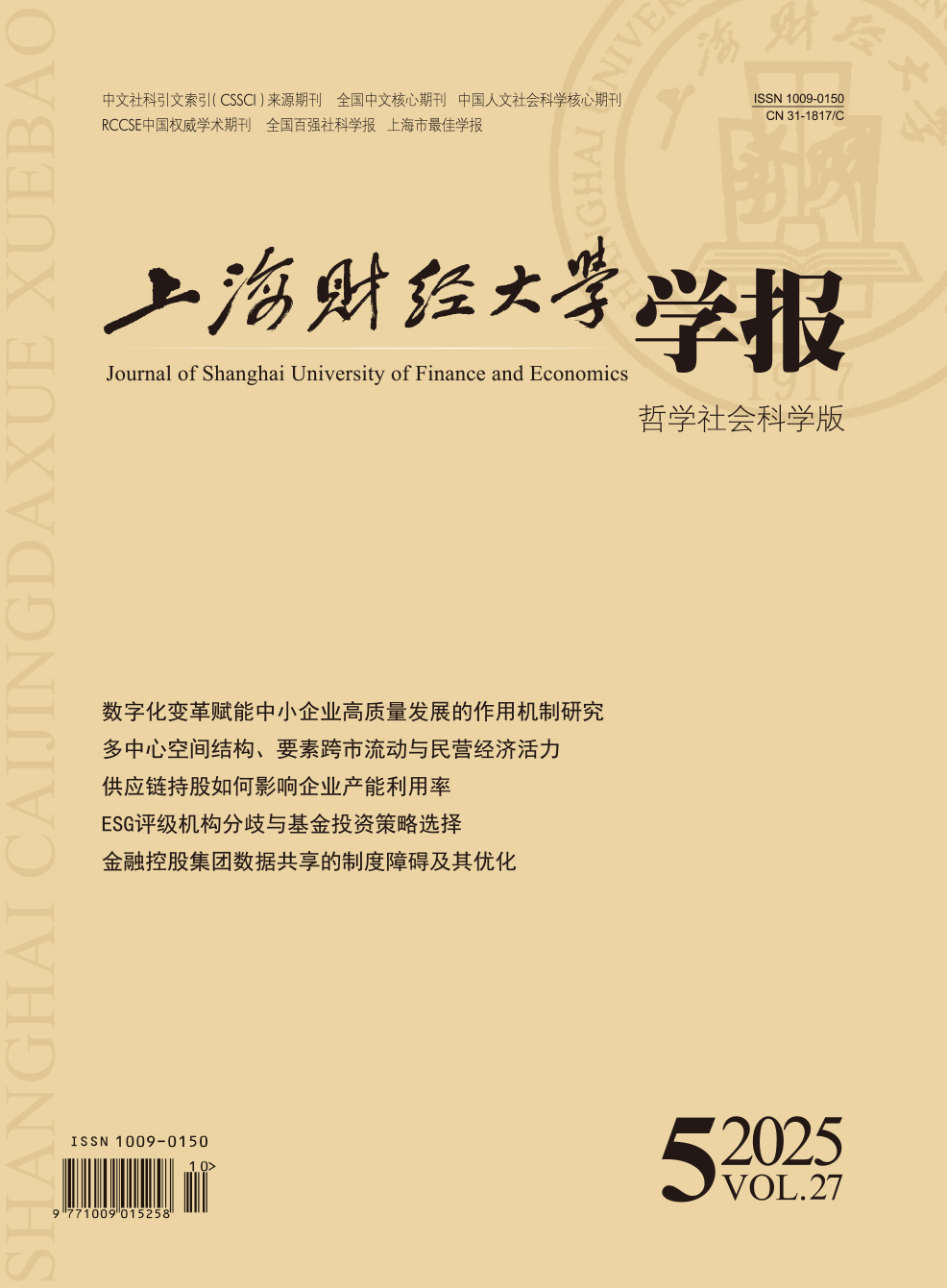
Journal of Shanghai University of Finance and Economics
LiuYuanchun, Editor-in-Chief
ZhengChunrong, Vice Executive Editor-in-Chief
GuoChanglin YanJinqiang WangWenbin WuWenfang, Vice Editor-in-Chief
The Institutional Barriers and Optimization of Data Sharing in Financial Holding Groups
Journal of Shanghai University of Finance and Economics Vol. 27, Issue 05, pp. 123 - 137 (2025) DOI:10.16538/j.cnki.jsufe.2025.05.009
Summary
References
Summary
Cite this article
Yuan Kang, Wei Yang. The Institutional Barriers and Optimization of Data Sharing in Financial Holding Groups[J]. Journal of Shanghai University of Finance and Economics, 2025, 27(5): 123-137.
Export Citations as:
For