
 4557
4557  10467
10467Under the new circumstances, Western developed countries have implemented technological blockades and a series of “decoupling and chain breakage” strategies against China in the high-tech field, seriously impacting the stability and security of Chinese enterprises’ deep integration into the Global Value Chain (GVC) . Moreover, Chinese enterprises have been long locked in low value-added segments, further amplifying this risk. Against the backdrop of building a unified national market, promoting domestic market integration can fully leverage the advantages of a super large-scale domestic market, reshape international competitive advantages, and thus significantly enhance the GVC resilience of Chinese enterprises. However, how domestic market integration affects GVC resilience remains insufficiently explored. Additionally, most existing studies use indicators of commodity market integration to reflect the degree of domestic market integration, lacking in-depth exploration of factor market integration. Using data from China’s listed companies and Chinese cities, this paper deeply investigates the impact of domestic market integration on the GVC resilience of Chinese enterprises. The findings reveal that domestic market integration significantly strengthens the stability and security of enterprise GVC, thereby improving GVC resilience, which is mainly achieved through two channels: promoting the diversified allocation of supply chains, and facilitating the adjustment of domestic intermediate products. Meanwhile, domestic market integration has a more obvious effect on enhancing the GVC resilience of enterprises in cities with lower local protectionism, capital-intensive and technology-intensive industries, general trade enterprises, and enterprises with longer domestic production chains. Further analysis reveals that commodity market integration, factor market integration, and capital market integration significantly promote GVC resilience, while the effect of labor market integration is not significant. In addition, internal and external collaborative interaction and digital transformation exert a significant positive moderating effect. This paper not only expands the research boundary of market integration, but also provides important insights for strengthening the GVC resilience of Chinese enterprises and ensuring the security development of the Chinese economy from the perspectives of building a unified national market and promoting domestic market integration.
 / Journals / Journal of Shanghai University of Finance and Economics
Journal of Shanghai University of Finance and Economics
LiuYuanchun, Editor-in-Chief
ZhengChunrong, Vice Executive Editor-in-Chief
GuoChanglin YanJinqiang WangWenbin WuWenfang, Vice Editor-in-Chief
Towards the Way of Security Development: Domestic Market Integration and Value Chain Resilience
Journal of Shanghai University of Finance and Economics Vol. 28, Issue 02, pp. 78 - 92 (2026) DOI:10.16538/j.cnki.jsufe.2026.02.006
Summary
References
Summary
Cite this article
Lyu Meijing, Fang Hui, Wang Mengying. Towards the Way of Security Development: Domestic Market Integration and Value Chain Resilience[J]. Journal of Shanghai University of Finance and Economics, 2026, 28(2): 78-92.
Export Citations as:
For
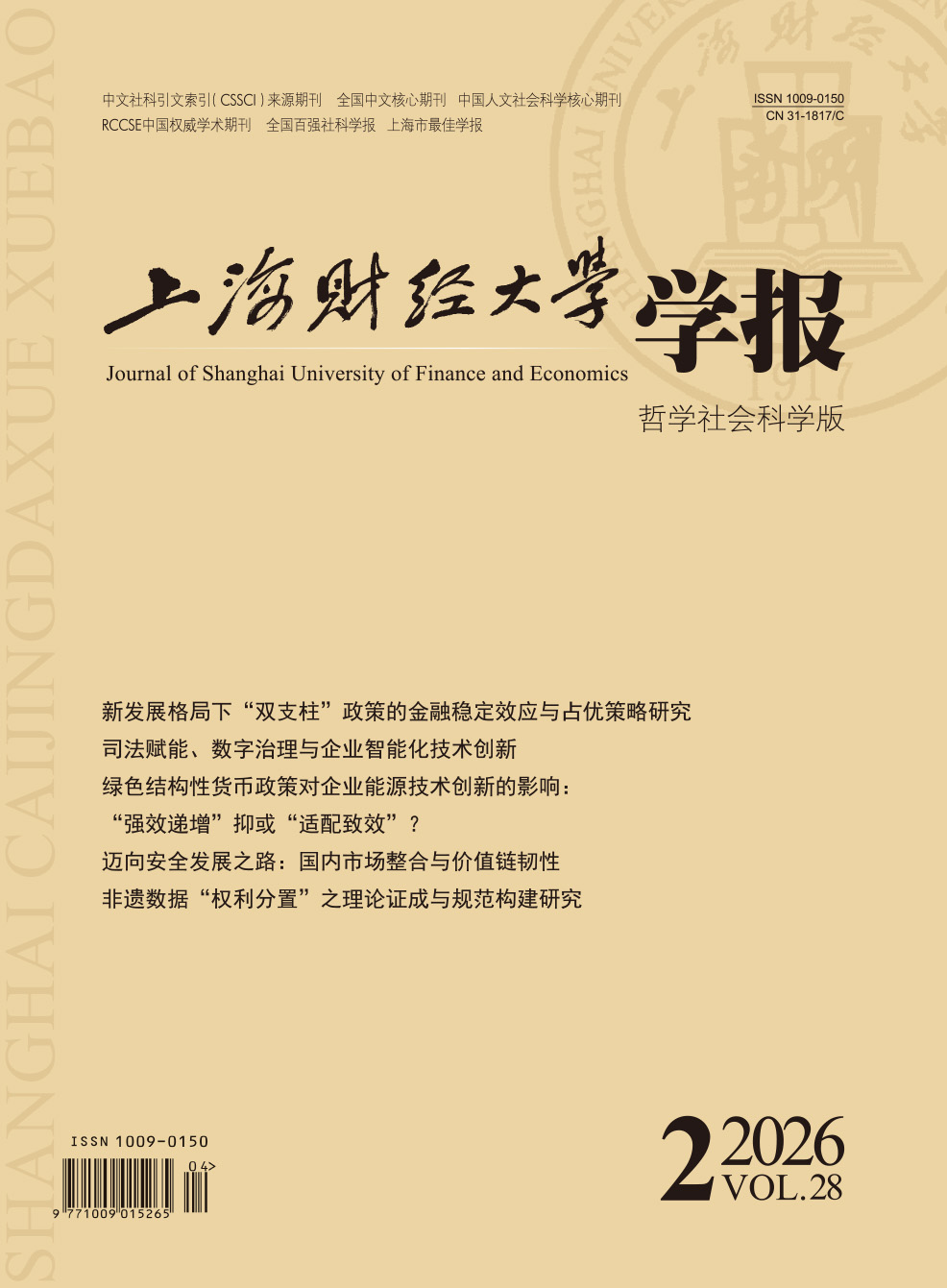
ISSUE COVER
RELATED ARTICLES